
SPECIES INDEX
Is the Pileated Woodpecker the Real Woody Woodpecker?
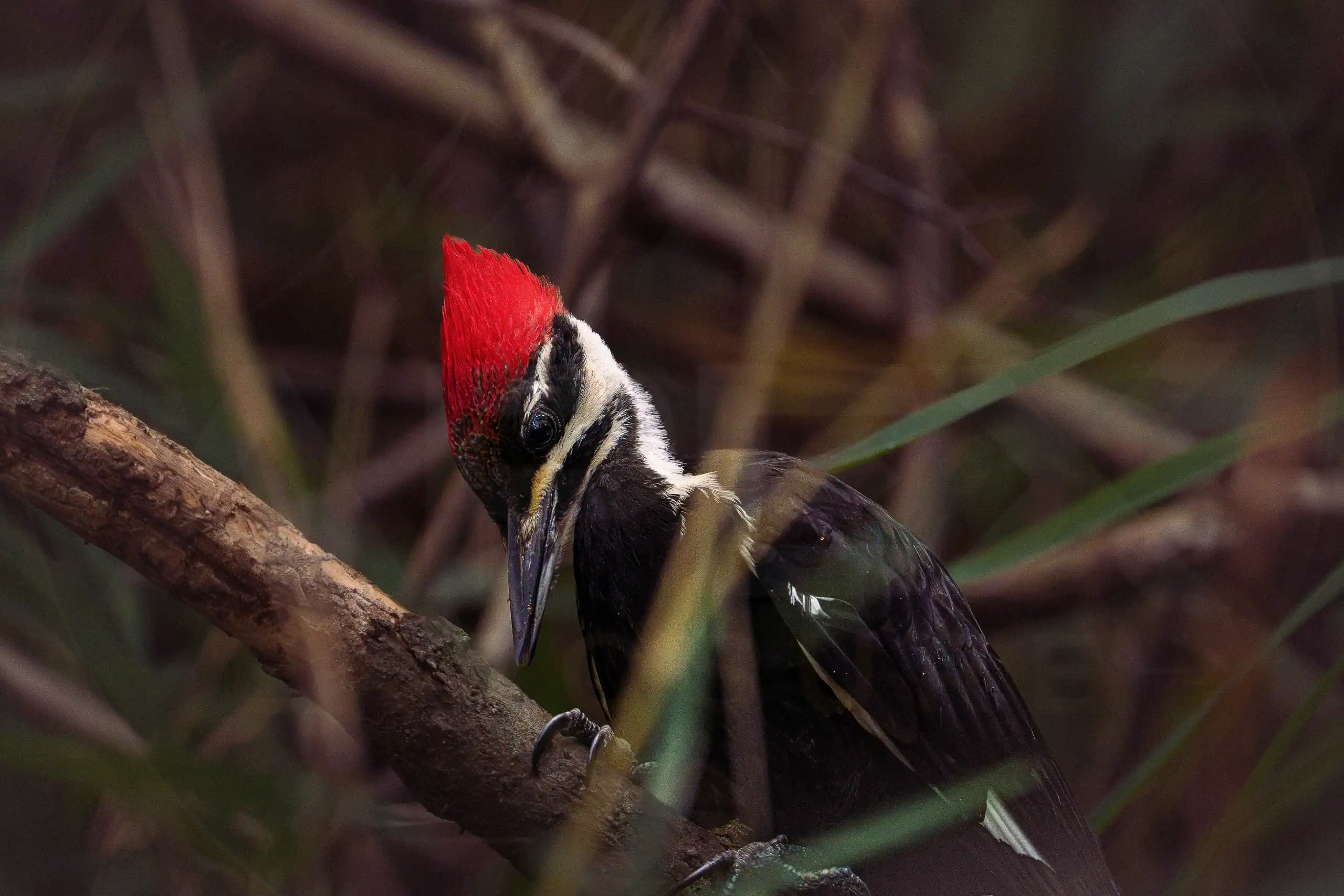
The pileated woodpecker is widely credited as the inspiration for Woody Woodpecker’s flaming red crest and rattling laugh — though cartoonist Walter Lantz later said the acorn woodpecker was his real model, and birders still argue about it. Whichever bird Woody’s actually based on, this one showed up mid-hike at Congaree National Park, working its way through the shaded understory along the boardwalk.
Identification
The largest woodpecker regularly found in North America — roughly crow-sized, with a mostly black body, bold white stripes down the neck, and a flaming red crest that’s visible from a long way off. Males show a red stripe (mustache mark) at the base of the bill; females lack it and have a black forehead instead of red.
In flight, look for large white underwing patches flashing against the black body — often the easiest way to identify one moving through the canopy at a distance.
Call & Drumming
Its call is a loud, ringing series of “kuk-kuk-kuk-kuk” notes, often described as wild and slightly maniacal-sounding — audible well before the bird itself is visible. Its drumming is equally distinctive: deep, loud, and resonant, produced by striking dead wood in long rolls to communicate territory rather than to forage.
Habitat & Range
Pileated woodpeckers need mature forest with a supply of large dead and dying trees to excavate and forage in. They’re non-migratory, year-round residents across most of the eastern United States and Canada, with additional populations in the Pacific Northwest. Congaree National Park‘s old-growth floodplain forest, full of standing deadwood, is prime habitat.
Diet & Foraging
Carpenter ants make up the bulk of the diet, supplemented by wood-boring beetle larvae and other insects, along with fruit and nuts when available. Pileated woodpeckers excavate large, distinctive rectangular holes in dead wood to reach ant galleries deep inside a trunk or branch — a feeding sign that’s often easier to spot than the bird itself.
Nesting & Ecosystem Role
Pairs excavate a large nest cavity in a dead or dying tree, a process that can take three to six weeks. Once abandoned, these cavities are frequently reused by a long list of other species — wood ducks, owls, other woodpeckers, and various mammals — making the pileated woodpecker a genuine keystone species in mature forest ecosystems.
Conservation Status
Listed as Least Concern by the IUCN Red List. Populations declined significantly in the early 20th century as mature forest was cleared for logging and agriculture, but federal protection in the 1920s and decades of forest regrowth brought the species back — today’s estimated population runs well over two million birds.
Photographed by Apex Exposure Media
Locations Documented
Apex Exposure Media has documented the pileated woodpecker at the following location(s). This list will grow as new sightings are added.
- Congaree National Park, South Carolina — clinging to a branch in shaded woodland vegetation.