
SPECIES INDEX
What Does a Barred Owl Sound Like?
A barred owl’s call sounds like it’s asking “who cooks for you, who cooks for you-all” — an eight-note hoot that carries far through the trees. We heard that exact call drifting out of the swamp at Congaree National Park fifteen seconds into a hike, days before we ever spotted the owl making it.
How Do You Tell a Barred Owl From a Great Horned Owl?
They’re often confused, but a few field marks make it easy once you know them. Barred owls have no ear tufts and dark eyes with a yellow bill; great horned owls have prominent ear tufts and yellow eyes with a dark bill. Barred owls run smaller — 17 to 24 inches long with roughly a 4-foot wingspan and 1 to 2 pounds — against a great horned owl’s 18 to 25 inches, up to 5-foot wingspan, and 3-plus pounds. The calls are just as distinct: a barred owl’s rhythmic 8-to-9-note “who cooks for you” against a great horned owl’s deeper, slower 4-to-5-note “hoo-hoo-hoo, hoo-hoo.”
Identification
The barred owl is a large, round-headed owl. Its plumage is a mix of brown and white: horizontal barring across the chest and vertical streaking down the belly, which is where the “barred” name comes from. Adults measure roughly 17–24 inches long with a wingspan of 39–43 inches, and typically weigh between 1 and 2 pounds. As with most raptors, females run larger than males.
Look closely and you may catch its nictitating membrane — a translucent third eyelid, distinctly blue-tinted in this species, that sweeps diagonally across the dark eye from the inner corner. It closes to protect and clean the eye while the owl flies through brush or handles prey, without blocking vision the way a full blink would.
Call & Sound
Its classic call is an eight-to-nine-note hoot with a rising-falling cadence, often rendered as “who cooks for you, who cooks for you-all.” It carries far through the trees and is fairly easy to imitate once you’ve heard it — from a distance it can sound almost like a dog barking, but up close it’s unmistakable. Barred owls also produce cackles, gurgles, hisses, and an extended, almost monkey-like call used between pairs during courtship or territorial disputes. They’ll call during the day as well as at night, especially in overcast conditions or when a pair is communicating across a territory.
Habitat & Range
Barred owls favor mature and old-growth forest with a closed canopy, especially bottomland hardwoods, swamps, and forest near rivers and wetlands — habitat that provides both large trees with nesting cavities and open understory for hunting. Congaree National Park‘s old-growth floodplain forest is close to ideal habitat for the species.
The species is native to the eastern half of North America but has expanded significantly westward over the past century, moving through the boreal forest of Canada into the Pacific Northwest. There it has become a serious conservation concern: barred owls now compete with, displace, and occasionally hybridize with the threatened northern spotted owl, and wildlife agencies have taken the controversial step of removing barred owls from some spotted owl habitat to slow the decline.
Diet & Hunting
Barred owls are opportunistic hunters, watching quietly from a perch before dropping onto prey below. Small mammals — voles, mice, squirrels, and rabbits — make up the bulk of their diet, but they also take amphibians, reptiles, crayfish, and fish, and will occasionally catch smaller birds. Unlike many owls, they’re comfortable hunting during daylight as well as at night, particularly at dawn and dusk.
Nesting & Reproduction
Pairs nest in cavities of large, mature trees, and will also use abandoned hawk or crow nests or artificial nest boxes when a natural cavity isn’t available. A clutch is typically 2–3 eggs, incubated for about 28–33 days. Barred owls are non-migratory and largely monogamous, often holding the same territory — and the same mate — for years.
Conservation Status
The barred owl is listed as Least Concern by the IUCN Red List, with a large and stable — in many areas expanding — population. It’s considered a strong indicator of healthy, mature forest habitat, since it depends on the large trees and closed canopy that only intact older forest provides.
Photographed by Apex Exposure Media

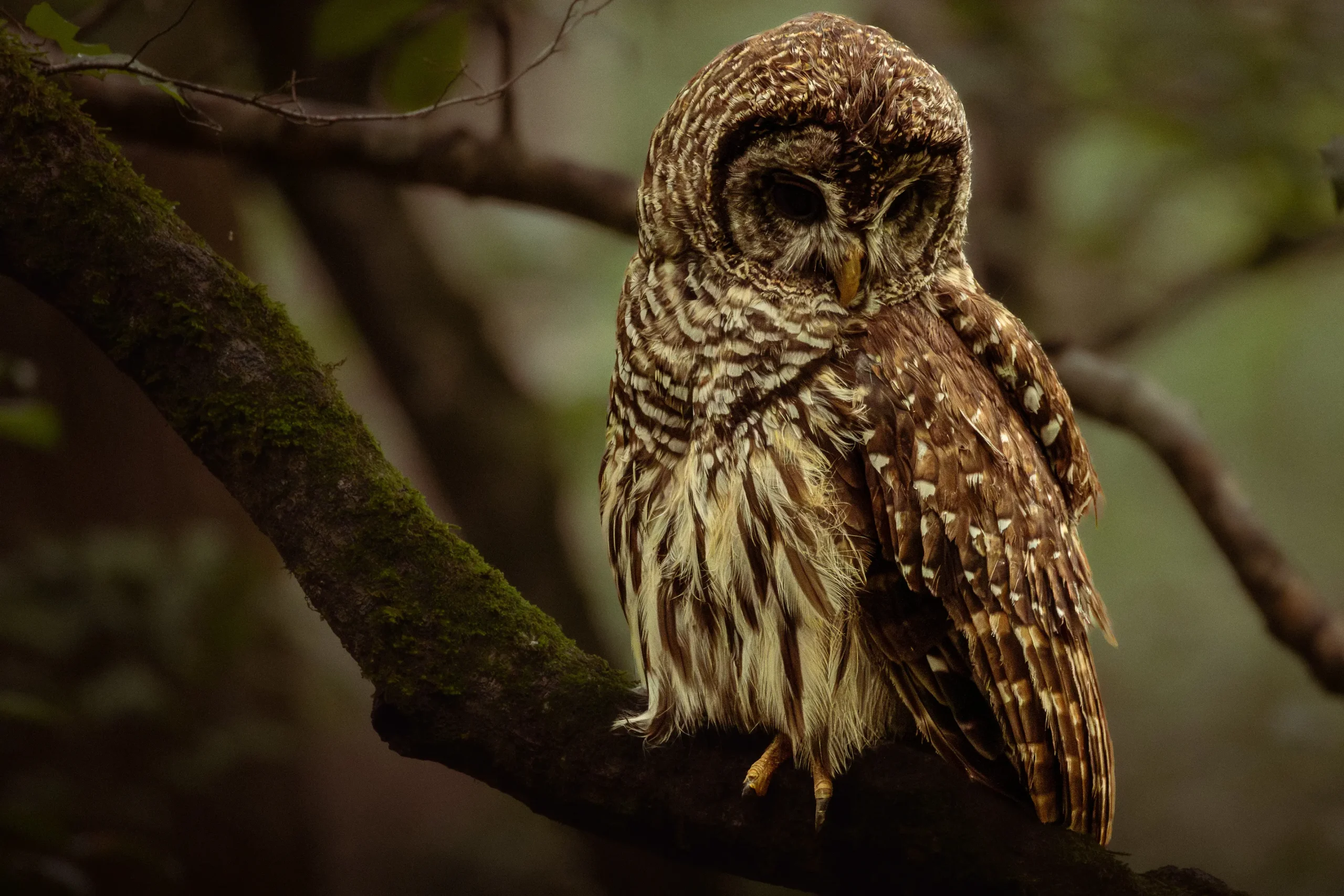


A related Barred Owl photograph, “Watchful Silence” — listed in the shop as Barred Owl Portrait in Soft Forest Light — is available as a limited framed fine-art print.
Locations Documented
Apex Exposure Media has documented the barred owl at the following location(s). This list will grow as new sightings are added.
- Congaree National Park, South Carolina — roosting on moss-covered branches beneath the old-growth floodplain canopy.