
SPECIES INDEX
Why Does the Black-and-White Warbler Climb Trees Like a Nuthatch?
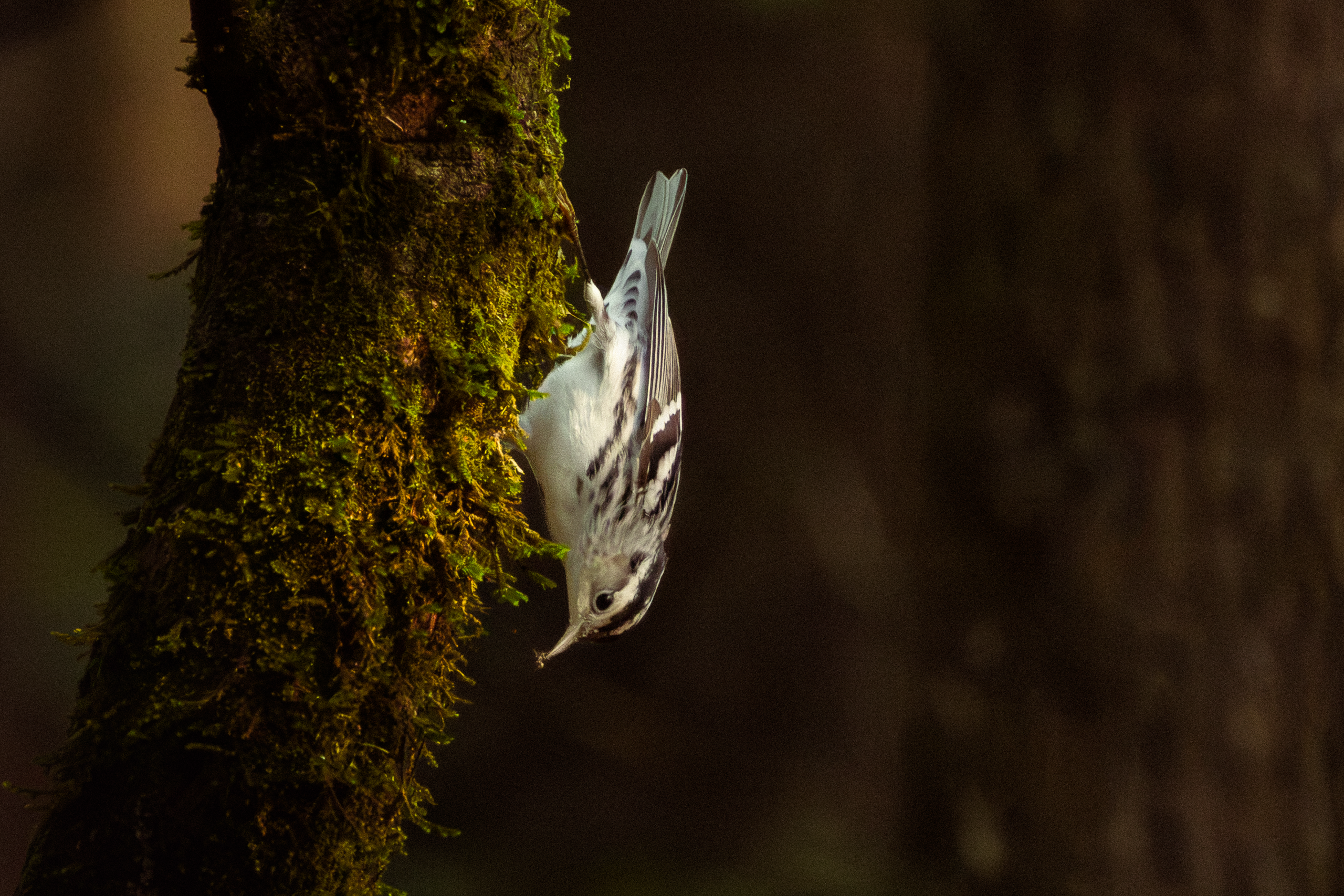
The black-and-white warbler is the only North American wood-warbler that forages on tree bark instead of leaves, creeping headfirst up and down trunks and branches like a nuthatch — a habit distinctive enough that it used to be called the “black-and-white creeper.” We caught one doing exactly that at Congaree National Park, working headfirst down a moss-covered trunk, probing the bark with its slightly downcurved bill.
Identification
Small and unmistakably striped, black and white from crown to tail with no other color in the plumage — often described as looking like it’s wearing a “flying humbug” candy pattern. Breeding males show a solid black throat and cheek; females and immatures have a white throat and paler grey cheek. Look for white undertail coverts marked with black spots, and a fairly long, slightly downcurved bill built for probing bark crevices.
Call
A thin, high-pitched, repetitive song usually rendered as “weesy-weesy-weesy-weesy,” often compared to a squeaky wheel. Its call notes include a sharp “chip” and a soft “seet,” sometimes given in flight.
Habitat & Range
Black-and-white warblers breed across northern and eastern North America, from the Northwest Territories to Newfoundland and south through the Appalachians, and winter from Florida and the Caribbean south to Peru — a long-distance migrant. They favor mature deciduous and mixed forest with plenty of trunk and limb surface to forage on. Congaree National Park‘s old-growth floodplain forest, thick with moss-covered trunks, is exactly that kind of habitat.
Diet & Foraging
Insects and spiders make up nearly the entire diet, especially caterpillars, beetles, and ants gleaned from bark crevices and lichen — a food source most other warblers ignore in favor of foliage. Foraging bark instead of leaves also gives this species an early-spring advantage, letting it find food before the forest canopy has fully leafed out. It occasionally takes anoles on its Caribbean wintering grounds.
Nesting & Reproduction
Unusually for a bird that spends its foraging life on tree trunks, the black-and-white warbler nests on the ground, tucking a cup nest of grass, bark strips, and dry leaves at the base of a tree or under cover. Females lay four to five eggs and incubate alone for 10–12 days; chicks fledge just 8–12 days after hatching.
Conservation Status
Listed as Least Concern by the IUCN Red List, with a stable population as of the most recent assessment. Habitat loss and forest fragmentation on both breeding and wintering grounds remain the primary long-term threats.
Photographed by Apex Exposure Media
Locations Documented
Apex Exposure Media has documented the black-and-white warbler at the following location(s). This list will grow as new sightings are added.
- Congaree National Park, South Carolina — climbing headfirst down a moss-covered trunk in the forest understory.