
Anhinga: The Bird That Swims With Only Its Neck Showing
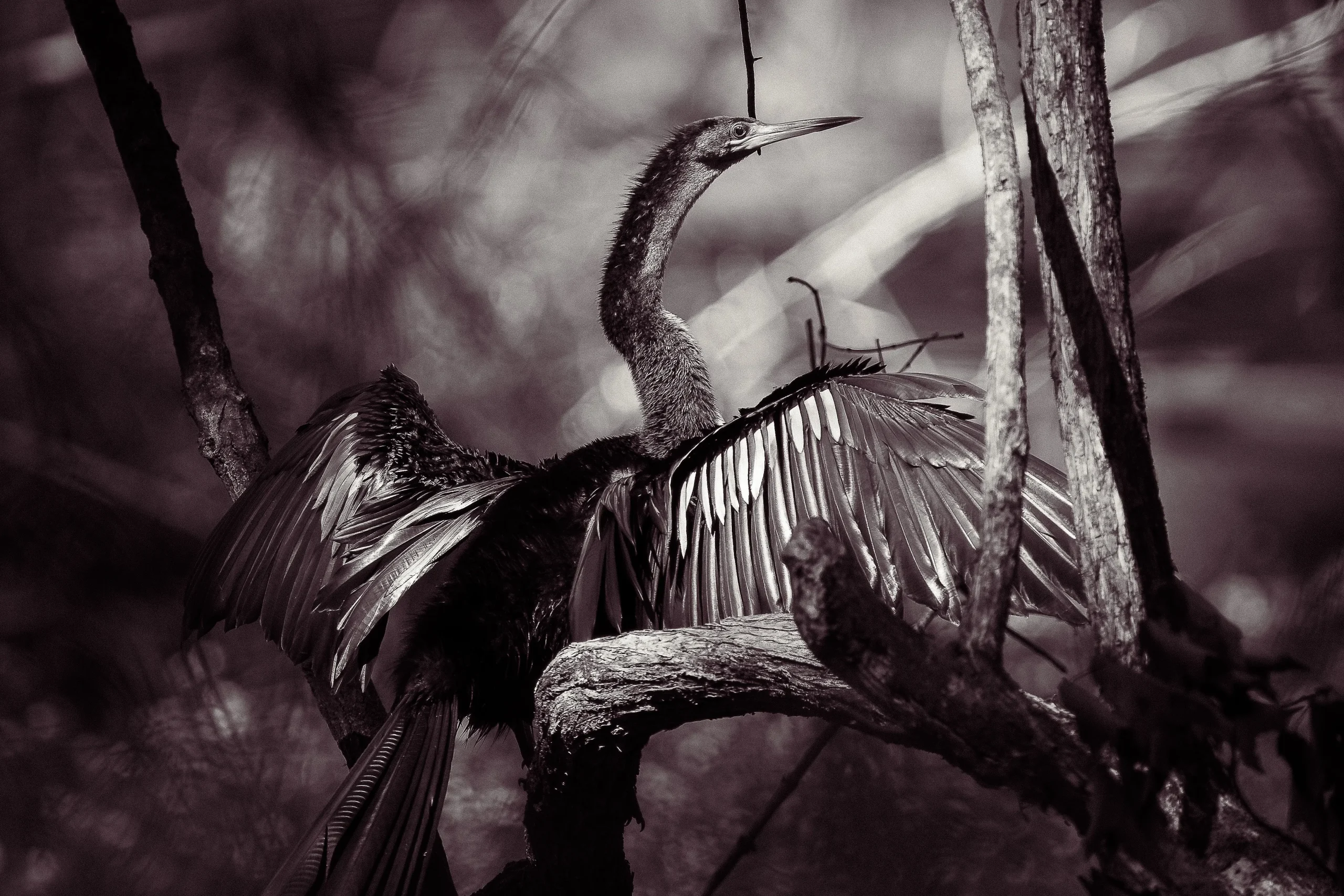
You will usually see an anhinga one of two ways: a thin snake-like neck moving across open water with no body attached to it, or a black cross-shaped bird sitting in a sunny gap with its wings held all the way open. Both are the same adaptation. The anhinga gets wet on purpose, and everything about how it hunts follows from that.
We have photographed it at Congaree National Park and at Congaree Creek Heritage Preserve.
Why it swims submerged
Most waterbirds work hard to stay dry. The anhinga does the opposite.
It has a reduced uropygial (preen) gland and plumage that soaks through readily. Combined with unusually dense bones, that gives it close to neutral buoyancy in water.BOW A bird that floats has to fight its way under; a bird at neutral buoyancy can simply hang in the water column and move slowly through submerged vegetation. That is precisely the anhinga’s hunting method — a patient underwater stalk rather than a dive.
WORTH CORRECTING
Anhingas are widely described — including, until now, on this site — as having no oil gland at all. That overstates it: the gland is reduced, not absent. And preen oil does not really waterproof any bird’s feathers in the first place; it conditions them.BIRDORABLE We would rather fix our own page than repeat a tidy explanation that isn’t accurate.
Why it stands with its wings open
The short answer everyone gives is “it’s drying off.” That is part of it, and for a soaked bird it matters. But the better-supported explanation is temperature.
Anhingas have unusually low metabolic rates and unusually high rates of heat loss, and the spread-wing posture is used to absorb solar energy to offset both.STANFORD Thermoregulation first; drying alongside it.
This is genuinely useful if you are trying to photograph one. It means an anhinga in a sunny gap is not about to leave. It will hold that pose far longer than a bird that is merely drying would, which is why the wing-spread frames are the ones most worth waiting for.
Identification
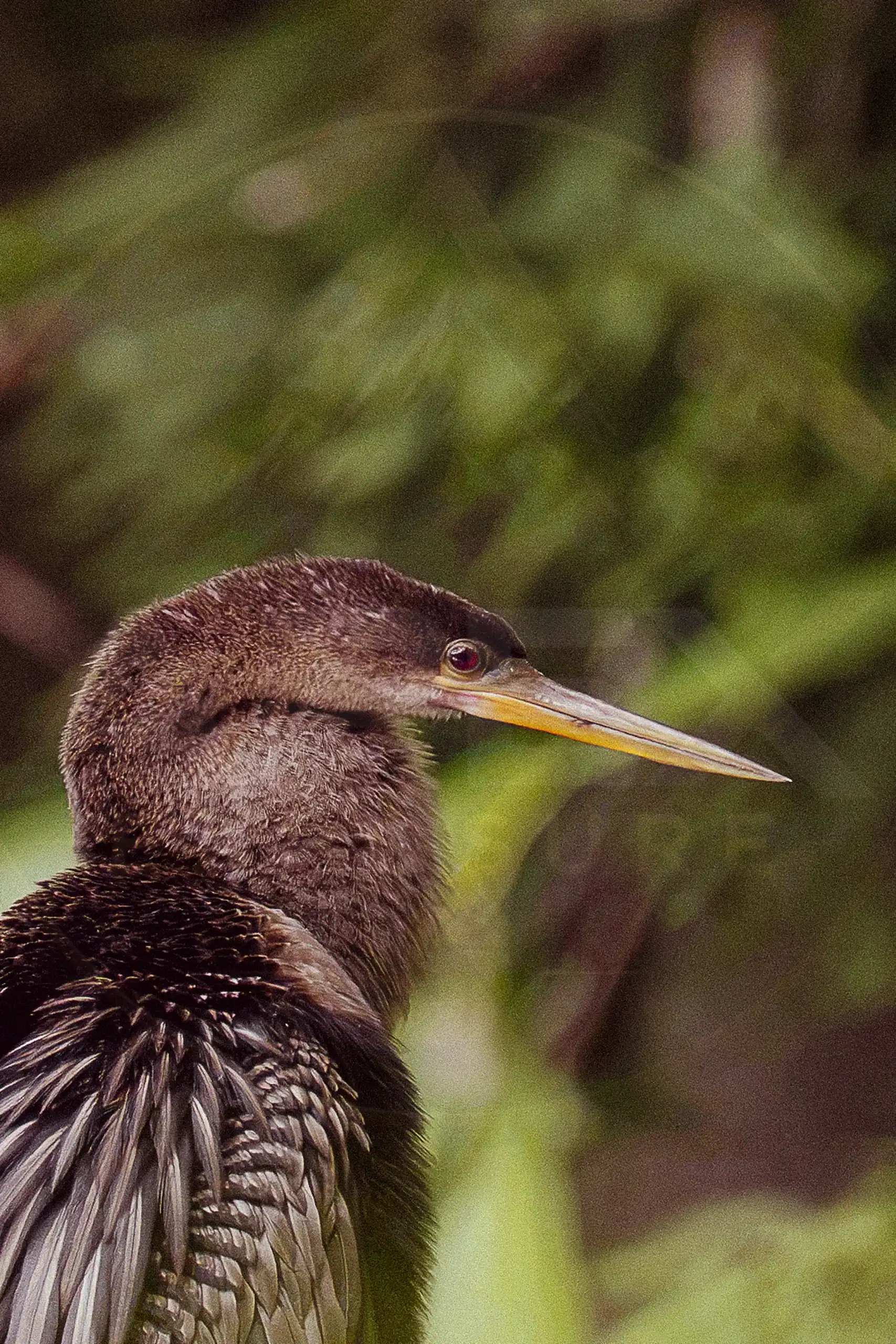
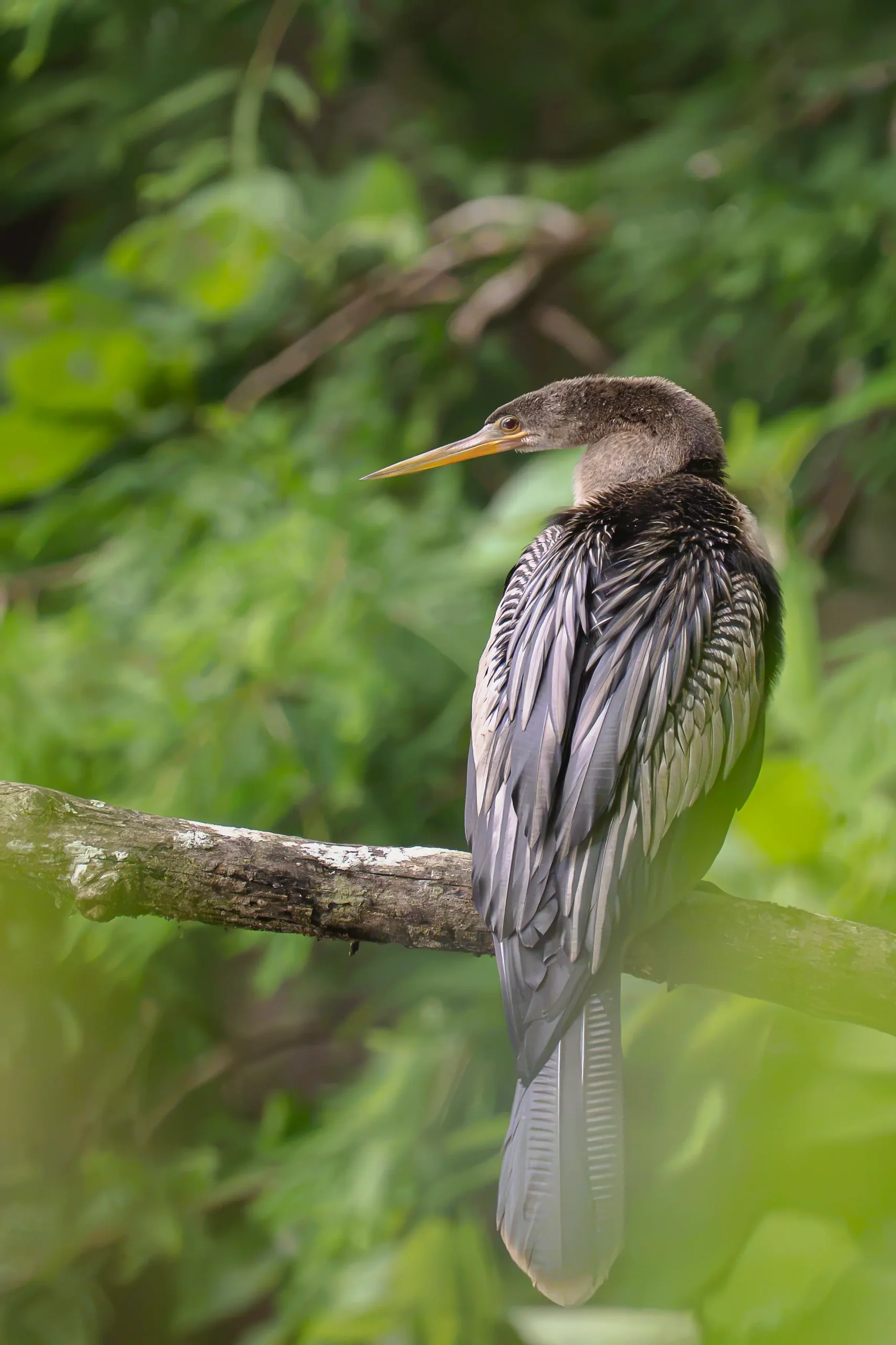
A large, slender waterbird — roughly 33 to 36 inches long, with a wingspan of about 3.7 feet.CLO The shape is the giveaway: a long S-shaped neck, a straight dagger-like bill, and a long fan-shaped tail that genuinely resembles a turkey’s, which is where the old name water turkey comes from.
- Adult male — black, with silvery-white streaking across the back and wings.CLO
- Female and immature — pale tan head, neck and breast; bill, legs and feet yellowish-orange.CLO
- In flight — it looks like a flying cross: wings held flat, neck and tail straight out.CLO
If you are deciding between this and a cormorant, the bill settles it in one second — straight and pointed on an anhinga, hooked on a cormorant. → Full comparison, with our photographs of both
Call
Largely silent away from the nest. Near a nest, or when disputing a perch, anhingas produce a loud buzzing clatter, along with rolling grunts and whistles during courtship. We have not recorded one calling.
Habitat and range
Warm, shallow, sheltered fresh water: swamps, wetlands and slow-moving rivers with perches nearby for drying. Year-round residents across the southeastern United States from North Carolina to Texas, and south through Mexico, the Caribbean and much of South America.
South Carolina sits comfortably inside that range, and the floodplain habitat at Congaree is exactly what the species wants.
Diet and hunting
Fish, amphibians and aquatic invertebrates. The anhinga stalks underwater with its neck folded back, then straightens it in an instant to spear the prey, surfaces, flips the fish into the air and swallows it head-first.
Conservation status
Listed as Least Concern by the IUCN, across a very large range spanning the Americas. In the United States it is protected under the Migratory Bird Treaty Act.
Where we found it
FIRST-HAND — Heath Johns, July 11, 2026
Congaree Creek Heritage Preserve. We had spent the better part of an hour on a great blue heron that would not hold still, and came away with nothing usable. On the way out, an anhinga was sitting with its wings fully open, drying, and simply stayed there. It is still the best wing-spread frame we have.
FIRST-HAND — Heath Johns, July 13, 2026
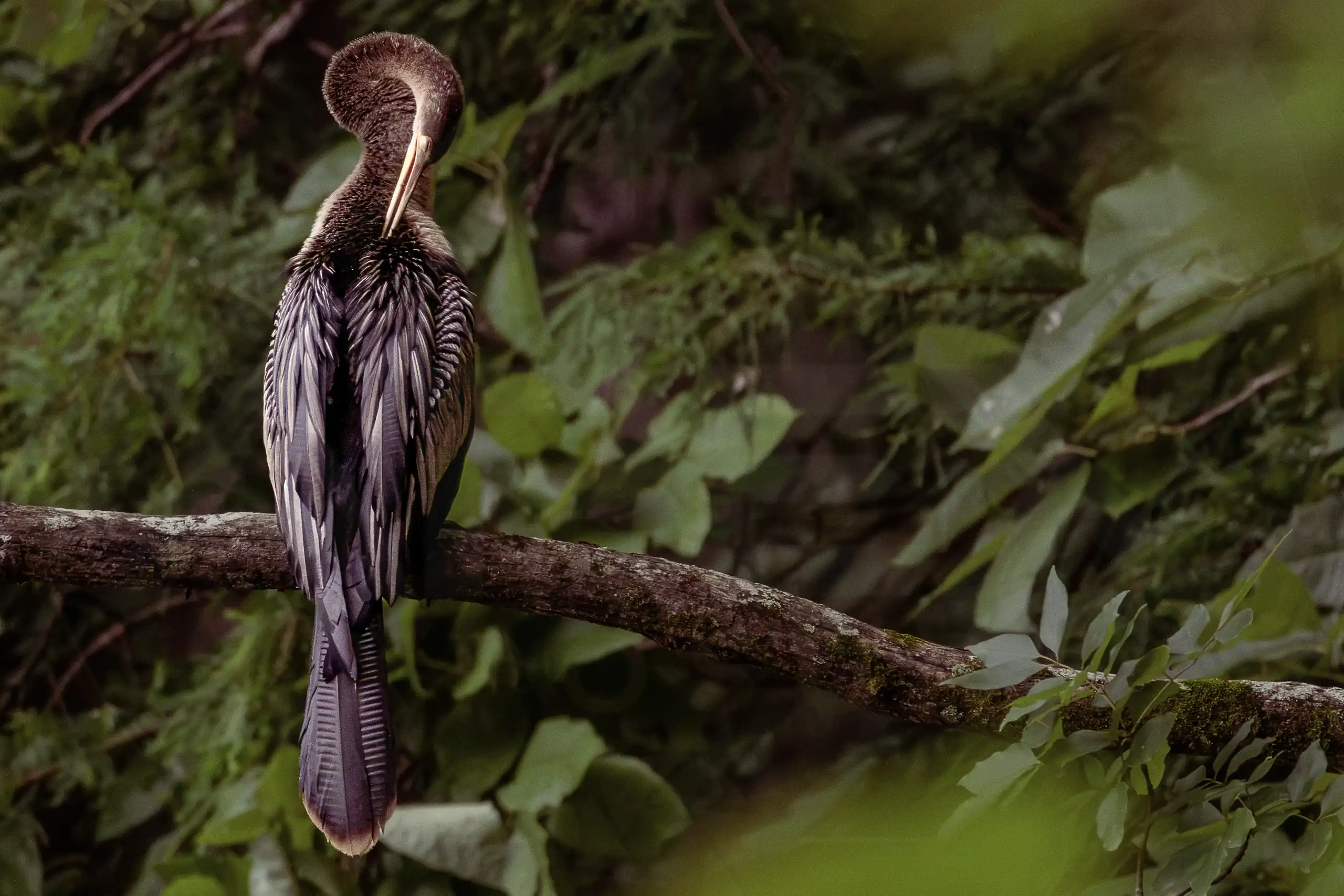
Congaree National Park. A second anhinga near the water during a three-hour outing with no target species at all. This one gave us the close profile and the take-off frames.
Plates
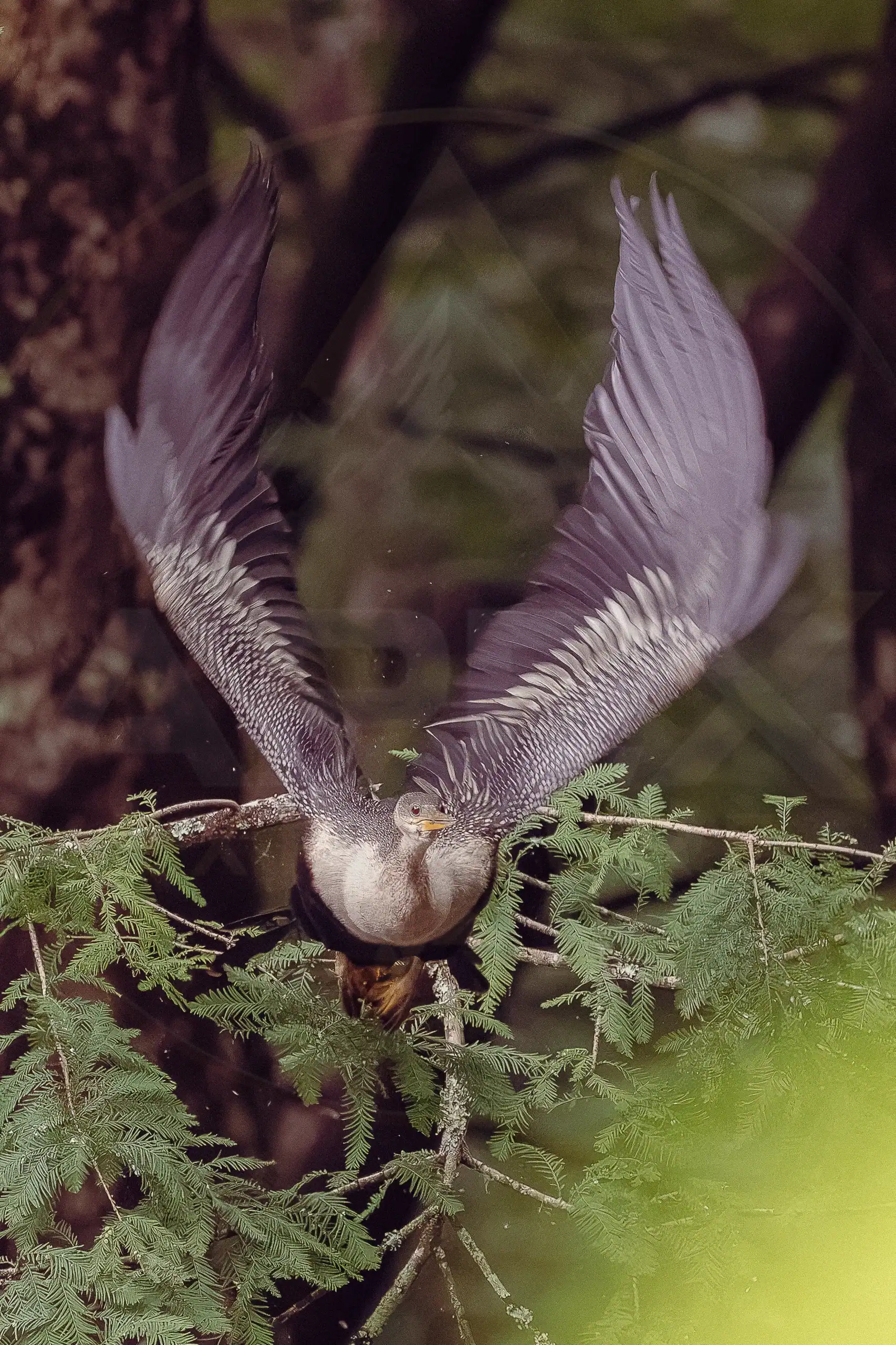
Locations documented
- Congaree National Park — perched, preening and taking flight in the forest wetlands
- Congaree Creek Heritage Preserve — drying its wings above the wetland