
SPECIES INDEX
Great Blue Heron
Ardea herodias
Identification
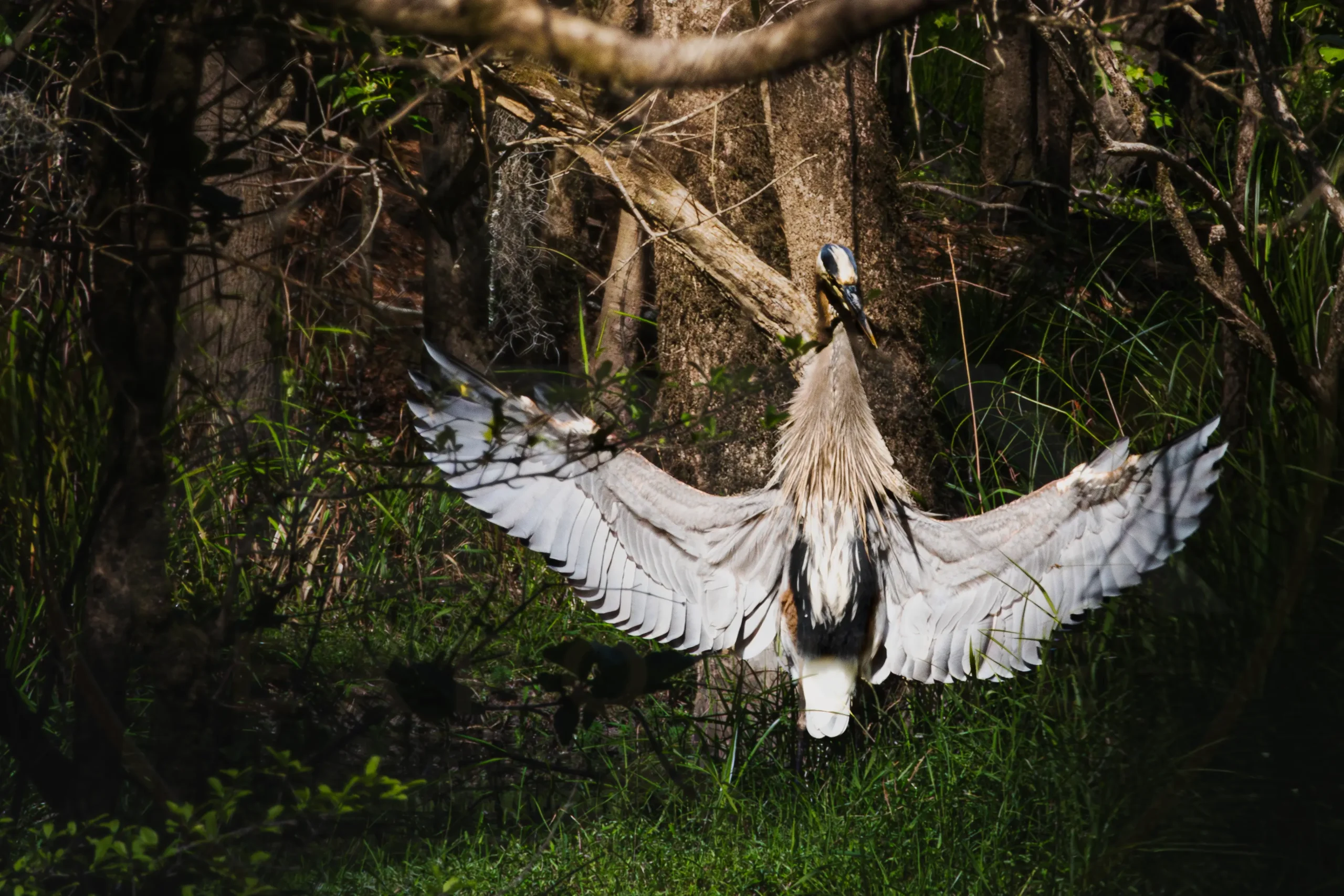
The largest and most widespread heron in North America, standing up to four feet tall with a wingspan approaching six feet. Blue-gray plumage covers most of the body, with a white head marked by a black stripe over the eye and long plume feathers trailing from the back of the crest during breeding season. In flight, it holds its long neck folded back into an S-shape, distinguishing it from cranes, which fly with necks extended.
Hunting Behavior
It hunts by patience rather than pursuit — wading slowly through shallow water or standing motionless for long stretches, waiting for prey to come within range before striking with a fast, precise jab of its bill. Despite its size, it’s a wary bird that generally keeps a cautious distance from anything approaching, which makes a close, undisturbed encounter genuinely hard-won.
Habitat & Range
A familiar sight along rivers, marshes, lakes, and wetlands across nearly all of North America. Great blue herons in the southeastern U.S., including South Carolina, are typically year-round residents, while northern populations migrate south for winter.
Diet
Fish make up the majority of the diet, but great blue herons are opportunistic and will also take frogs, small reptiles, crustaceans, and even small mammals and birds when the chance arises. Prey is typically swallowed whole.
Nesting & Reproduction
Great blue herons nest colonially in “heronries,” often high in trees near water, sometimes alongside other wading bird species. A clutch usually runs 2–6 eggs, and both parents share incubation and feeding duties.
Conservation Status
Listed as Least Concern by the IUCN, with a large and stable population across its range. It remains sensitive to wetland habitat loss and disturbance near nesting colonies, but is not currently considered at risk.
Photographed by Apex Exposure Media

This portrait — titled “The Watcher” — is available as a limited-edition fine-art print.
Locations Documented
Apex Exposure Media has documented the great blue heron at the following location(s). This list will grow as new sightings are added.
- Congaree Heritage Preserve Wetland, South Carolina — photographed across multiple outings to this location.