
SPECIES INDEX
Why Are Canada Geese So Aggressive?
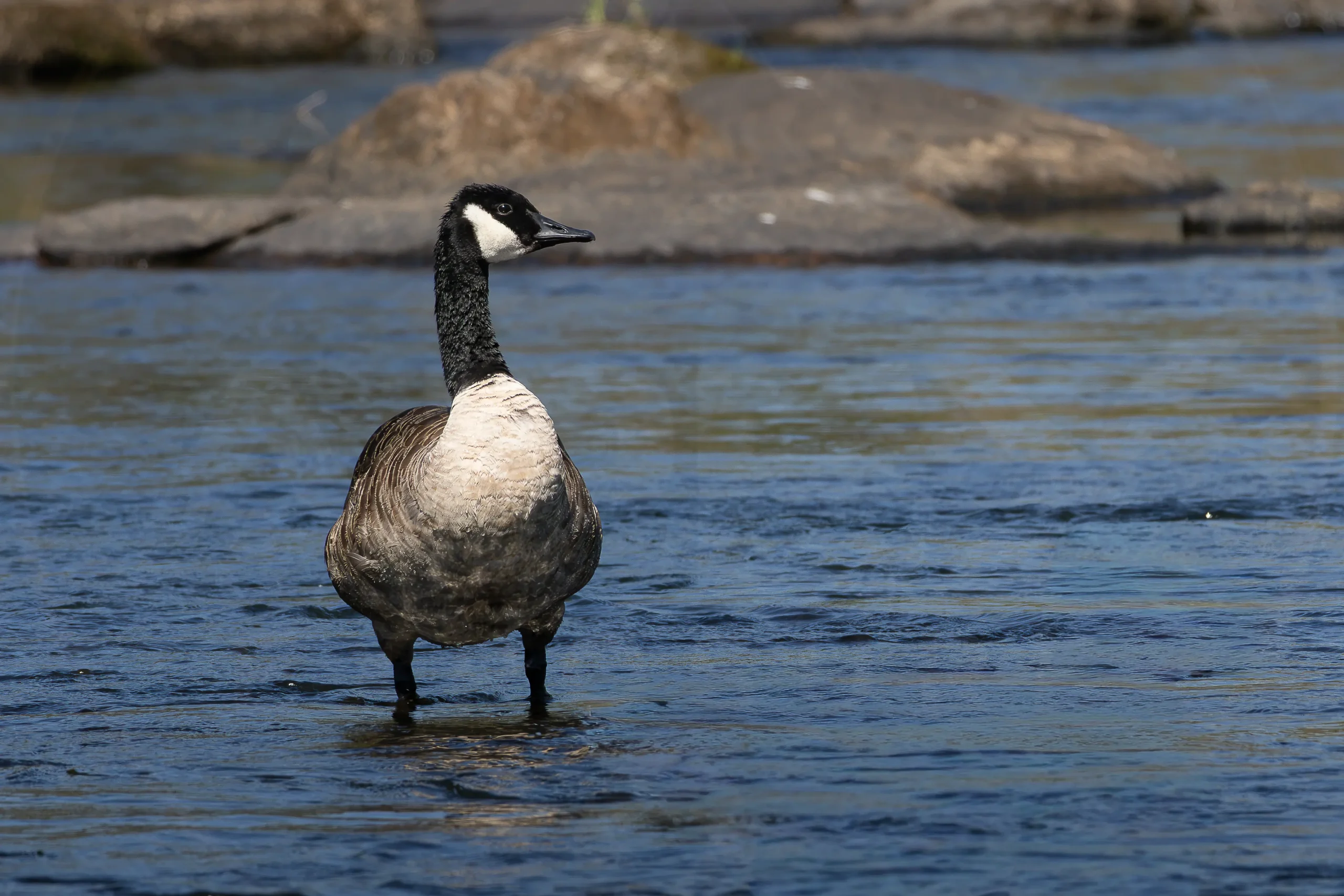
Canada geese aren’t aggressive by nature — the hissing, charging, and wing-strikes are almost always about defending a nest, goslings, or territory, and it peaks hardest in spring. Habituation to humans in parks and urban waterways only makes the standoffs more common, since these geese have largely lost their fear of people. This one wasn’t rattled by much of anything, holding its ground in the current at Saluda Riverwalk.
Identification
A large, familiar goose with a black head and neck, a bold white cheek patch running under the chin, and a brown body. Adults typically measure 30–43 inches long with a wingspan of roughly 50–73 inches; males generally run larger than females.
Call
The classic loud “honk” comes from males; females give a shorter, higher-pitched “hrink.” Canada geese use roughly ten distinct calls in total, covering everything from flock contact notes to alarm and aggression warnings.
Habitat & Range
Native across Arctic and temperate North America, Canada geese favor fresh water, marshes, and estuaries, but they’ve adapted remarkably well to lawns, parks, and urban waterways with nearby water and open grass. The Lower Saluda River at Saluda Riverwalk in Columbia, South Carolina, fits that pattern closely, and this one was perfectly at home in the shallow current.
Diet & Feeding
Primarily herbivorous, Canada geese graze on grasses and aquatic plants, along with beans, wheat, rice, and corn when available near agricultural land. Urban populations will also pick through garbage and handouts, which is part of why they’ve become so comfortable around people.
Nesting & Reproduction
Females lay two to nine eggs, typically five, in a shallow, plant-lined nest set in an elevated spot near water. Incubation runs 24–32 days, and goslings fledge at six to nine weeks — the stretch when parents are at their most defensive. Many populations have also shifted from migratory to year-round resident, thanks to abundant lawns and mild urban winters.
Conservation Status
Listed as Least Concern by the IUCN Red List, with a large and stable-to-increasing population — millions of birds across North America. In many urban and suburban areas, the species is managed as a nuisance rather than a conservation concern.
Photographed by Apex Exposure Media
Locations Documented
Apex Exposure Media has documented the Canada goose at the following location(s). This list will grow as new sightings are added.
- Saluda Riverwalk, Columbia, South Carolina — standing in the shallow current of the Lower Saluda River.